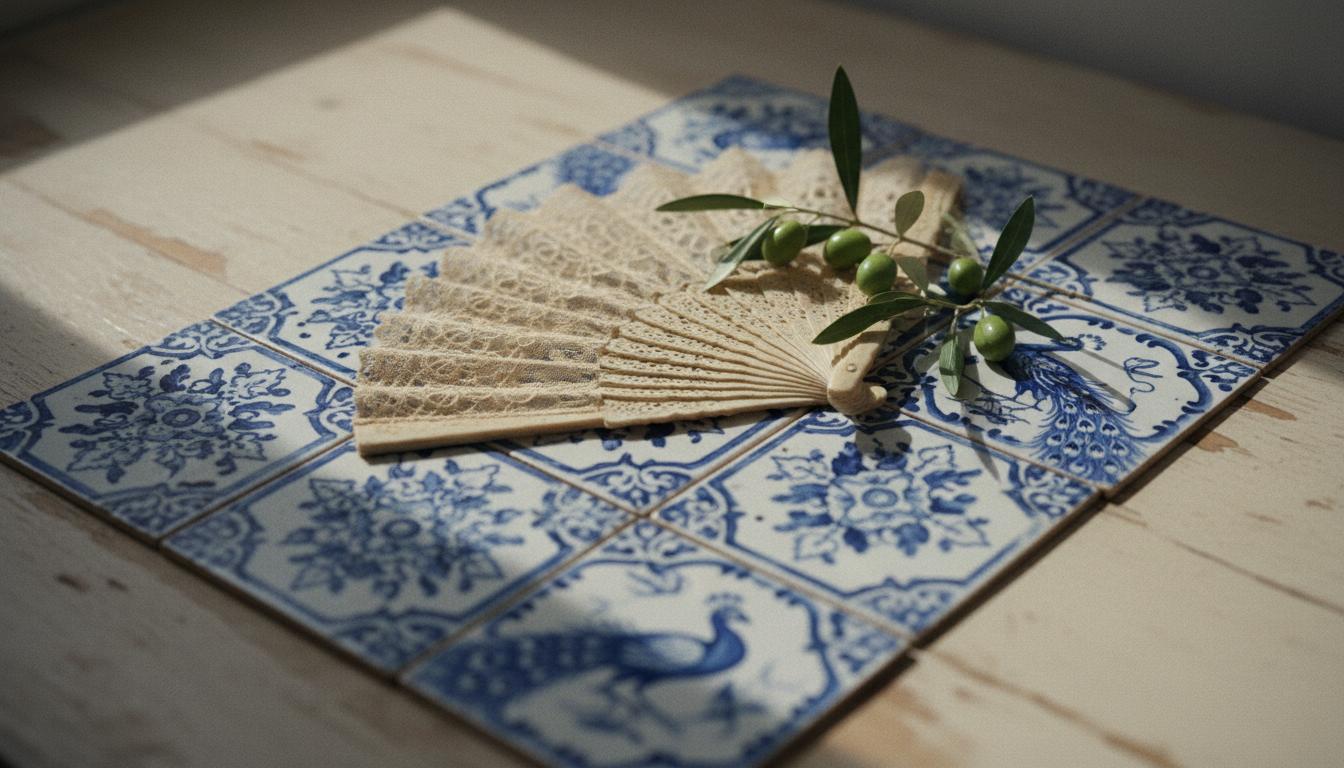
Blue and White Forever
There is a particular white — cool, faintly blue, like milk in shadow — that belongs to the north. It is the white of porcelain glaze and blown crystal, and for two and a half centuries the courts and capitals between the Baltic and the Danube have refined it into a complete domestic aesthetic. Two cities still sell it from the source.
Copenhagen first. Royal Copenhagen was founded in 1775 under royal protection, and every piece since has carried three wavy blue lines — Denmark's three straits — under its foot. The manufactory's twin poles define the whole tradition: Blue Fluted, the cobalt lace pattern painted by hand since the founding year, each piece signed with its painter's initials; and Flora Danica, the botanical service begun in 1790 for Catherine the Great, still painted from the great flora atlas, plate by impossible plate. Turn any cup over: the painter's mark beside the waves is the entire argument — a human hand, accountable, in an age of anonymous surfaces.
A few doors along Strøget, the tradition widens from clay to metal and wood. Georg Jensen, the sculptor-silversmith who opened his workshop in 1904, made silver modern — blossoms and hammered surfaces first, then a century of collaborations that gave Danish design its canon in miniature. And Illums Bolighus gathers the whole Nordic argument under one roof: four floors where Wegner chairs, PH lamps, and Bojesen's teak monkey stand as a permanent survey of a national idea — that beauty is a civic virtue, available at every scale down to a wooden animal.
Vienna answers with light. J. & L. Lobmeyr, glassmakers since 1823 and purveyors to the imperial court, still trade from their creaking-parquet shop on Kärntner Straße, sixth generation of the family presiding. The house made the chandeliers of the Vienna Opera and the starburst fixtures of the Metropolitan Opera; but its true masterpieces fit in the hand — muslin glasses blown so thin they seem to abolish themselves, wine services that weigh less than the wine. Ask to hold one. Staff expect it. The near-weightlessness is a demonstration no photograph can make.
What joins Copenhagen's blue and Vienna's clear is a shared theory of luxury: refinement as subtraction. Not more ornament — more control. A thinner wall, a steadier brushstroke, a truer curve. These are houses where the eighteenth century's standards survived because nobody ever decided they were negotiable.
Buy one perfect thing in each city — a Blue Fluted cup, a muslin glass — and use them daily. That, too, is the northern idea: the best things belong on the table, not behind it.
Article references
The houses in this story
- Royal Copenhagen Flagship Strøget, Copenhagen
Danish porcelain — the Royal Copenhagen flagship on Amagertorv has sold hand-painted blue-fluted porcelain since 1775. The hand-painting workshop is visible through glass walls. store page → · open in the atlas → - Georg Jensen Amagertorv 4, Copenhagen / Online
The silversmith of the North since 1904 — Art Nouveau hollowware to Ilse Crawford; the Amagertorv flagship gleams like a vault opened for visitors. store page → · open in the atlas → - Illums Bolighus Amagertorv 10, Copenhagen / Online
Four floors of Danish design orthodoxy since 1941 — the department store as national museum, everything purchasable. With artistic consultant Brita Drewsen, Dessau's BO presented fully arranged interiors rather than isolated stock — contemporary accounts describe the 1925–28 concept as previously unseen. store page → · open in the atlas → - J. & L. Lobmeyr Kärntner Straße 26, Vienna
Glass since 1823 — lit the world’s first electric chandelier with Edison, hangs today in the Met Opera; muslin glasses thin as held breath. store page → · open in the atlas →