Bucklesbury is a London design house whose umbrellas are handmade in England, made by craftsmen the brand describes as continuing London's umbrella-making tradition back to 1805 — the same period the city's oldest surviving umbrella manufacturers trace their own founding to.
Best for English-made umbrellas with a solid single-piece chestnut or maple shaft
Bucklesbury is a London design house whose umbrellas are handmade in England, made by craftsmen the brand describes as continuing London's umbrella-making tradition back to 1805 — the same period the city's oldest surviving umbrella manufacturers trace their own founding to. Its Classic range is built around a beechwood shaft; the London Umbrella, its higher-tier model, is cut from a single piece of chestnut wood for men's versions and maple for women's, rather than an assembled multi-piece stick.
Every umbrella is marketed under Bucklesbury's own "Rain Tested in England" standard and ships in a branded gift box with a cotton dust bag, positioning the line at the gift and luxury-accessory end of English umbrella-making rather than a working trade counter. The company also makes handmade Italian leather bags and England-bound hand-bound journals, running the umbrella line alongside a small stable of English- and Italian-made goods rather than as a single-product workshop.
Operating from Marsh Wall in London's Docklands, Bucklesbury reads as a newer design house explicitly built on the city's older umbrella-making lineage, distinguishing its top model by the solid single-piece wood shaft that its Classic range doesn't share.
Founded in London in 1868 by Thomas Fox, and hand-building umbrellas at its Wickham Road, Croydon works since 2006, Fox Umbrellas offers gents', ladies', golf and telescopic models with handles in hardwood, Malacca, whangee or horn.
Best for British-made umbrellas with a genuine choice of handle craftsmanship
Fox Umbrellas was founded by Thomas Fox in 1868 in the City of London. The company moved into its purpose-built factory on Wickham Road in Shirley, Croydon in April 2006, and it is from that current works, not a single 1868 site, that it has made umbrellas by hand for the last two decades, continuing a hand-building tradition that stretches back to the firm's founding. The range runs from tube and stick-frame gents' umbrellas to ladies' models, golf umbrellas, telescopic folding designs and parasols, alongside walking sticks and raincoats, with bespoke commissions available for customers who want a specific combination of size, canopy and handle. Handles are offered across a genuine spread of materials - hardwood, Malacca cane, whangee bamboo, leather, maple, and pieces finished with horn insets - rather than a single house style, letting an umbrella be built closer to a piece of furniture than a disposable accessory. The firm's umbrellas have appeared on screen in productions including Atomic Blonde and Peaky Blinders, and the retailer Sir Gordon Bennett credits Fox with appearances 'from James Bond to Atomic Blonde' among the films that have used its umbrellas, a reputation the brand trades on without needing to claim any single title. Prices for ready-made models run roughly 90 to 240 pounds and up depending on handle and frame, with the workshop shipping worldwide from its current Croydon site.
Trading from its largely unaltered Victorian shopfront at 53 New Oxford Street since 1857 (founded 1830), James Smith & Sons is generally credited as London's oldest umbrella shop, with its own in-house repair department.
Best for London's oldest umbrella shop - an almost unaltered 1857 Victorian shopfront
James Smith founded this umbrella business in 1830 at Foubert's Place in Soho; his son later moved the main shop to 53 New Oxford Street in 1857, where it has traded ever since - long enough that it is generally credited as London's oldest umbrella shop. The New Oxford Street premises is largely unaltered: a mahogany, painted-glass and brass Victorian shopfront, with fittings inside dating to around the 1870s and polished wooden counters that have stayed in place through more than a century of trade, making the interior itself as much a draw as anything sold within it. The current range covers gentlemen's and ladies' umbrellas across several traditional constructions - solid stick, fit-up, pencil and birdcage models - plus walking sticks in country, town, ladies' and folding styles, seatsticks, and accessories finished in natural horn. Crucially, the shop maintains an in-house repair department that services the umbrellas and sticks it has made, rather than treating repair as an afterthought bolted onto retail. Locally, London cab drivers are said to know it simply as 'the umbrella shop,' a nickname that reflects how embedded the address has become in the city's daily geography near the British Museum. It functions as a working shop first, with the Victorian shopfront surviving as a byproduct of nearly two centuries of continuous trade rather than a restoration project.
Lockwood Umbrellas is a London manufacturer working out of a North London manufactory, with its retail presence at the Tea Building on Shoreditch High Street.
Best for Steel-framed, hand-sewn umbrellas with buffalo-horn handles and a choice
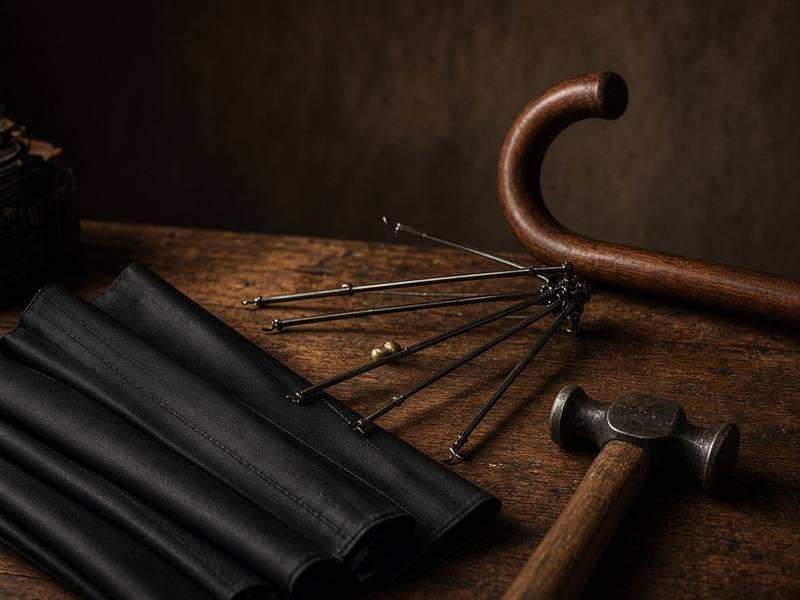
Lockwood Umbrellas is a London manufacturer working out of a North London manufactory, with its retail presence at the Tea Building on Shoreditch High Street. Each umbrella is built on a Grade A steel frame with hand-sewn reinforcements and lathe-turned brass fittings, construction the company frames as a deliberate return to centuries-old umbrella-making methods rather than a mass-produced frame.
The materials list is unusually specific for a modern maker: canopies in water-resistant cotton, handles in ethically sourced buffalo horn, and shafts turned from a choice of hardwoods — maple, chestnut, whangee bamboo, or bark ash — sourced from sustainable woodlands. That range of named timbers, alongside the horn handles, puts Lockwood's construction closer to the bespoke English shooting-and-country tradition of umbrella-making than to a fashion accessory line, built as pieces intended to be rebuilt and re-covered rather than replaced.
For a comparatively young addition to London's umbrella trade, Lockwood's combination of a steel-framed, hand-sewn build with sustainably sourced horn and hardwood detailing places it in direct company with the city's older manufacturers on construction quality, even without their multi-generational history.
 Visit official site ↗
 Visit official site ↗
 Visit official site ↗
 Visit official site ↗