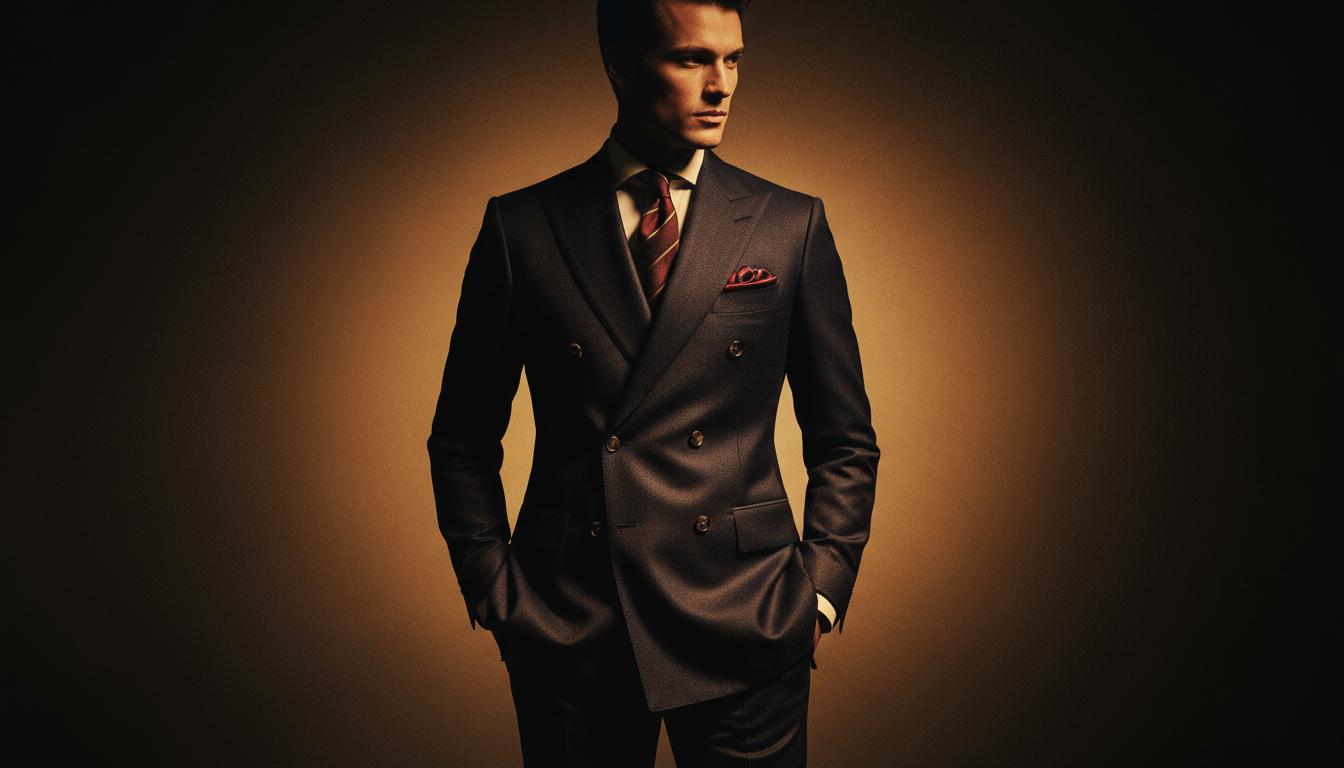
The Soft Shoulder
Every soft, unlined, natural-shouldered jacket in the world — and by now that is most of the good ones — descends from a single act of disobedience in Naples in the 1930s. Gennaro Rubinacci had opened his 'London House' in 1932 to dress Neapolitan anglophiles in English style. His cutter, Vincenzo Attolini, looked at the structured London jacket — the padding, the stiff canvas, the armor — and removed it. What remained draped from the shoulder like a cardigan and moved like a shirt. The English suit had been translated into Italian, and the translation was better suited to being alive.
The houses that descend from that room still work within walking distance of each other's tradition. Rubinacci itself remains in family hands three generations on, presided over by Mariano and Luca, with an archive of vintage cloth that tailoring pilgrims speak of in hushed terms — commissioning a jacket from a decades-old length of wool is the house's singular offer. The Attolini name continues under Cesare Attolini, still family-run, making jackets whose shirt-shoulder — the spalla camicia, sleeve set with deliberate shirring — is the style's visible signature, executed with hours of handwork per garment.
Kiton, founded by fabric merchant Ciro Paone in 1968 in nearby Arzano, industrialized nothing and scaled the handwork instead: hundreds of tailors, a house school to train the next generation of hands, and cloth bought at the top of the world's fiber auctions. It is the empirical answer to the question of what tailoring's ceiling looks like.
And because a Neapolitan is not dressed until the knot is right, E. Marinella has stood on the Riviera di Chiaia since 1914, cutting generous seven-fold-quality ties from English-printed silks, hand-finished in Naples, sold from a shop the size of a kiosk to presidents who order by the dozen. The morning espresso offered to customers is part of the uniform.
The deeper point of the Neapolitan school is philosophical. English tailoring imposes a silhouette; Neapolitan tailoring negotiates one. The jacket concedes to the body — to heat, to gesture, to the shrug and the reach — and in conceding, flatters. That is why the style conquered menswear so completely that its origins are forgotten: soft tailoring now simply looks like good tailoring.
Go to the source anyway. Have a jacket made where the idea was born, try it one size closer than habit suggests, and buy the tie in the little shop by the sea. The suit was disassembled here so that it could finally fit.
Article references
The houses in this story
- Rubinacci Naples, Italy
The London House of Naples — Mariano’s dynasty that codified Neapolitan tailoring, Agnelli’s wardrobe. Named London House in 1932 for Gennaro's attachment to English fabrics and to London as the then capital of masculine elegance, while cutting the unpadded Neapolitan opposite of Savile Row. store page → · open in the atlas → - Cesare Attolini Naples / Online
Heir of the man who invented the unstructured Neapolitan jacket — hand-made perfection, no compromise. Historic workshop was on Via Vetriera; current flagship is on Via Filangieri. Robb Report (2010) says Vincenzo designed the slimmer, high-armhole jacket while working for Gennaro Rubinacci, then opened his own shop at 12 Via Vetriera before WWII. store page → · open in the atlas → - Kiton Arzano / Naples / Online
The summit of Neapolitan tailoring — fully hand-sewn suits from its Arzano ateliers, bespoke and beyond. On 30 April 2026 the Arzano industrial street that has hosted Kiton's headquarters since 1991 was renamed Viale Ciro Paone (ex Viale delle Industrie). store page → · open in the atlas → - E. Marinella Naples / Riviera di Chiaia / Online
The tiny Riviera di Chiaia shop tying the world's most famous seven-fold ties since 1914 — presidents dressed here. Original shop is 20 m². In the 1980s Italian president Francesco Cossiga presented boxes of five Marinella ties to visiting heads of state. store page → · open in the atlas →