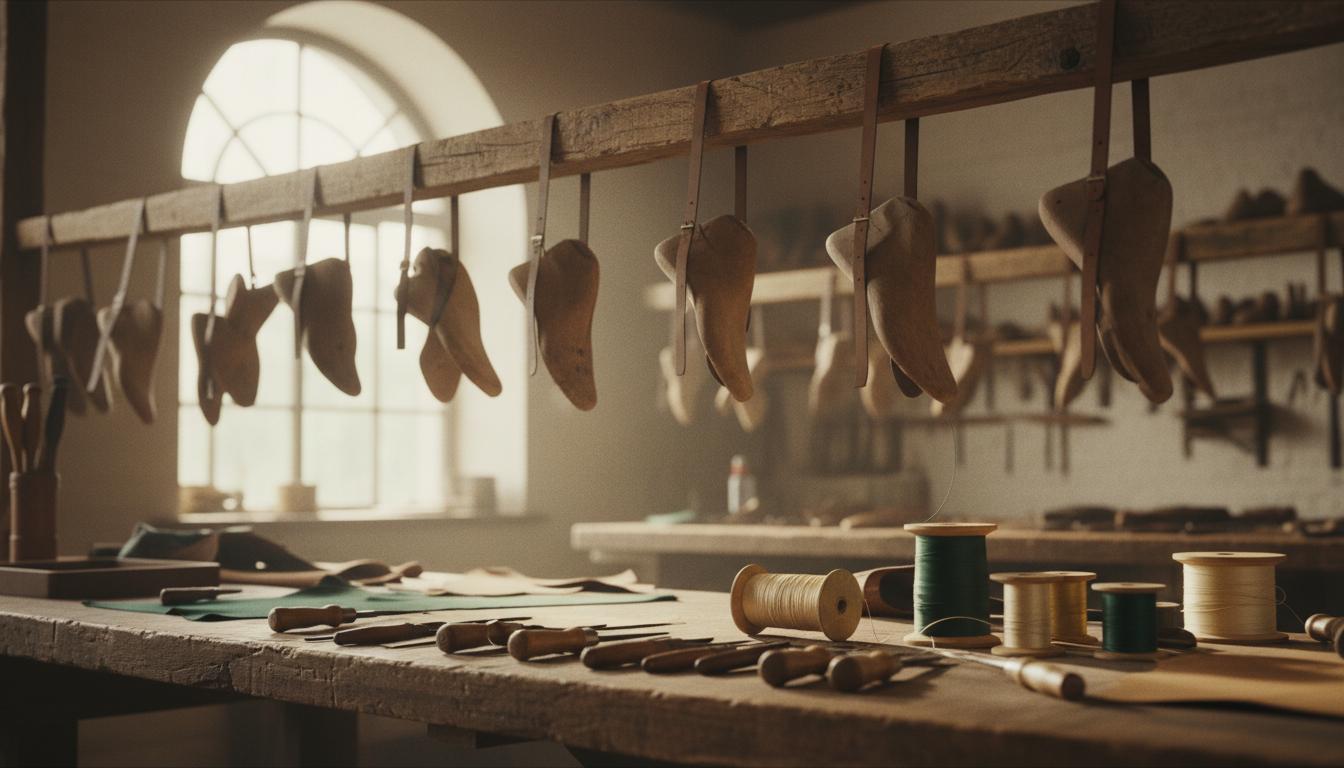
The Last Lasts
The last is the shoe's secret architecture: a carved wooden form, one per foot, on which everything else is built. In industrial shoemaking, lasts are standardized and anonymous. In the surviving bespoke houses, the last is a portrait — your feet, recorded in beech or hornbeam, kept in the archive for the rest of your life and sometimes longer. A few houses still work this way, and together they map the craft's remaining capitals.
Vienna holds the deepest archive. Rudolf Scheer & Söhne has made shoes on Bräunerstraße, steps from the Hofburg, since 1816 — seven generations of one family, purveyors to emperors whose lasts the house still keeps. There is no ready-to-wear line and never has been: measurement, a hand-carved last, trial fittings, and construction entirely by hand in the quiet Viennese manner. Families have measured generations here; the waiting list is counted in months and nobody apologizes for it.
London's claim runs through St James's. John Lobb, founded in 1866 by a Cornish farm boy who walked to the capital, holds royal warrants across reigns and exists today in two amicable branches: the family bespoke firm in London, and John Lobb Paris under Hermès, whose Northampton-made ready-to-wear line is the accessible summit of English shoemaking. Either way the standard descends from the same bench.
Northampton itself remains the trade's engine room. Church's, founded there in 1873, still Goodyear-welts its shoes through the traditional two-hundred-plus operations — a construction whose whole point is time: a welted shoe can be resoled again and again, and a black Consul captoe, refurbished on schedule, is measured in decades, not seasons.
Paris contributes color. Berluti, established in 1895 by an Italian bootmaker and shaped by four generations of the family, made the patina its art — translucent washes built up by hand into cognacs, plums, and blues of unusual depth, shoes finished like old furniture. Existing pairs can be sent back for re-patination as they age, which is the house's quiet admission that a shoe is never finished, only paused.
Why does any of this survive when a factory can sell you a passable oxford for a day's wage? Because bespoke shoemaking is one of the last crafts where the entire pre-industrial process — measurement, carving, welting, finishing — persists under one roof, unsimulated. The product is not really the shoe. It is the last in the archive: proof that somewhere in Vienna or London, your feet are on file, and the next pair needs no fitting at all.
Article references
The houses in this story
- Rudolf Scheer & Söhne Bräunerstraße 4, Vienna
Bespoke shoemakers since 1816, seventh generation — imperial-royal cobblers whose lasts of the Habsburgs rest in the workshop museum. store page → · open in the atlas → - John Lobb Paris / Northampton / Online
The Hermès-owned John Lobb house — its first Paris boutique opened in 1899, with bespoke made in Paris and ready-to-wear made in Northampton. The City II oxford, Lopez loafer and William double-monk carry its Paris-bespoke and English-making lineage. store page → · open in the atlas → - Church's Northampton, UK
Northampton shoemaker since 1873 — part of Prada Group. Consul, Dubai and Shannon lasts. The gold standard for British bench-made shoes. store page → · open in the atlas → - Berluti Paris
Parisian shoemaker since 1895 — the Alessandro wholecut, Venezia leather, and patina worked like watercolor. LVMH-owned, and still the summit of French men's shoes. store page → · open in the atlas →